
Patient Registries: What’s Design Got to Do with It?
The possibilities for patient registries have never been greater, and neither have the design choices. This series explores how to frame the registry, work through the tradeoffs, and put it to work.

Do you want the good news or the bad news first?
It doesn’t matter. They’re both the same.
There has never been a better time to start or redesign a patient registry.
The past 5 to 10 years have been an incredibly exciting time to be involved in patient registry design. A flood of new capabilities has become available.
- Connection and collaboration. Registries can bring patients, clinicians, and researchers together, support two-way communication, and keep communities engaged over time.
- Links to health systems and devices. They can connect with EHRs, claims data, wearables, devices, apps, and other systems.
- The full research cycle. They can incorporate other research projects, including clinical trials, surveys, and even other registries, and support the entire process from recruitment and enrollment through analysis and publication of results.
- Care and treatment decisions. They can give clinicians a clearer view of real-world outcomes and support decision-making at the point of care.
- Patient education and insights. They can return personalized information, education, and insights to patients based on their own data.
AI is accelerating both the breadth and speed at which new capabilities are developed. It is also becoming a new interface to the registry, helping people get data in through conversation and automated extraction and get value out through answers, summaries, and insights.
So what’s the bad news?
It’s been said that “…some of the heaviest things in life are unmade decisions” (Alex Hormozi).
As registry capabilities expand, so does the weight of the design decisions that come with them. There are more choices to make, those choices increasingly interact, and there is more pressure to decide not only what makes sense today, but how best to position the registry for what comes next.
So how best to sort this all out?
That’s the goal of this series in a nutshell. It’s designed for those involved in patient registry design, including clinician-researchers, disease organizations, research teams and consultants, and patient and family advocates.
The series will focus on three broad areas.
1. Think
James Gibson’s theory of perception demonstrates that what we perceive, and what actions appear possible, depend partly on the relationship between the person, the environment, and what that person is trying to accomplish. Likewise, everyone brings a particular understanding of what a “patient registry” means. That understanding carries assumptions, experiences, associations, and expectations that influence what we notice and what we consider possible.
We’ll start by stepping back from our personal understanding and looking at registries historically, including how the concept has evolved with new technologies and capabilities, broader roles in research and clinical care, and new ways to inform, educate, and engage patients.
We’ll also examine the registry within its environment to better appreciate its potential utility. A registry sits within patients and families, clinicians, researchers, organizations, health systems, studies, workflows, technologies, and communities.
How we frame the registry, and the direction we choose, will shape every design decision that follows.
2. Design
Design is where choices are made and the registry takes shape. Where we say yes to some possibilities and no to others. Where we take ownership of what the registry will become.
Those choices are connected. Increasing value in one area may increase burden somewhere else. Greater precision may require more effort. A choice that serves one stakeholder well may create additional work for another. The same design decision may be highly valuable in one registry and poorly suited to another.
The work of design is to understand those tensions and tradeoffs well enough to make the choices deliberately and shape them into a coherent registry.
3. Deliver
A registry should do more than accumulate information. Deliver is where the registry is put to work.
The focus shifts from what is collected to how that information is used, by whom, and to what end.
This is where the choices made through thinking and design are translated into practical value for the people and settings the registry was intended to serve.
Start somewhere
Keep in mind that registry development is an iterative process, so the goal is to establish a thoughtful starting point.
That starting point comes from enough clarity about what the registry can be, the direction you want it to go, and the major design choices needed to move forward with purpose. From there, experience will refine the design as new information, constraints, and opportunities emerge.
Ideally, this series is a resource you can return to throughout that process, whether you are starting a new registry, redesigning an existing one, or working through a particular decision along the way.
1 of 1 parts published (more coming…)
Patient Registries: What’s Design Got to Do with It?
The possibilities for patient registries have never been greater, and neither have the design choices. This series explores how to frame the registry, work through the tradeoffs, and put it to work.
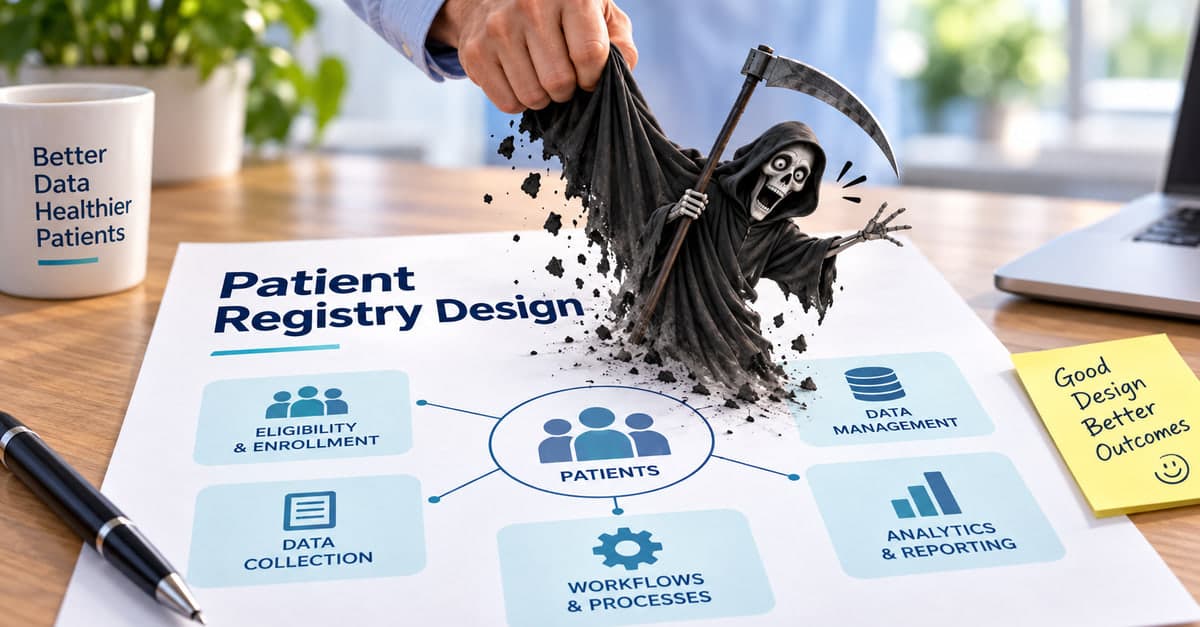
Removing the Grim from the Reaper
A pre-mortem asks you to imagine that your patient registry has already failed and work backward to understand why. The exercise helps widen the design space, uncover vulnerabilities, and reveal the broader range of factors that need to come together for a registry to succeed.
This material comes from a book in progress.
Designing something like this yourself?
Tell us what you are building and we will show you how it maps onto Studytrax.
Get started